Showing posts with label LAUSD Magnets. Show all posts

Sep 19, 2017

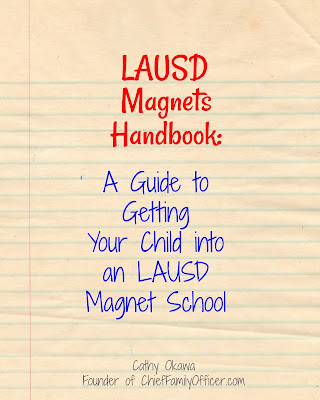
Announcing the LAUSD Magnets Handbook: A Guide to Getting Your Child into an LAUSD Magnet School

If you live within LAUSD boundaries and have a school-age child, or know someone who does, I have an incredible new resource for you. It's my just-published e-book, the LAUSD Magnets Handbook: A Guide to Getting Your Child into an LAUSD Magnet School.


This book demystifies the magnet school admissions process and answers your questions about what exactly that process is and how to navigate it. It's a short and easy read, but jam packed with the answers you need, like what points really are, how to apply to schools now so you can get your child into the school you really want him or her to go to later, and more!

Buy it today at Amazon for just $2.99!

FYI, the application for the 2018-2019 school year goes live on October 2. If you're trying to decide what school you want your child to attend in the next year or two, check out the Calendar of Important Dates at my web site dedicated to LAUSD Magnet Schools. I've added the magnet school application dates, as well as the dates of any school tours I could find online.

Oct 2, 2015

LAUSD Magnet Schools: What to expect after submitting your Choices application

After the Choices Application - chieffamilyofficer.com

Once you've submitted your Choices application, you might be wondering what happens next.

In December, the Student Integration Services office (which administers the Choices programs) will send out a Confirmation/Correction letter. If things stay the same as in years past, online applicants will receive an email stating that the you can view the letter online. If you submitted a paper application, SIS will likely send your letter via snail mail.

The Confirmation/Correction letter states that your application has been received, indicates which school you applied to, and any priority points your child may have. It also states whether any corrections are required.

If you applied to a Gifted/High Ability or Highly Gifted magnet program, you will receive a separate notification in January regarding your child's eligibility or ineligibilityfor the program. You can learn more about gifted magnet programs here.

Notification letters will be sent out in March. If things stay the same as in the past, all letters will be sent via snail mail, regardless of how your applied. However, online applicants may be able to view their letters online even before receiving their snail mail letter. If your child is accepted to a school you'd like him or her to attend, be sure to follow the instructions in the letter to claim your spot. And congratulations!

Original image via FreeDigitalPhotos.net by Grant Cochrane.

Apr 6, 2015

LAUSD: Maximizing Your Chances of Admission Through Open Enrollment

Getting in via Open Enrollment - chieffamilyofficer.com

What can you do if you want your child to attend an LAUSD school that's not your "home school" or a magnet school, and you don't qualify for any of the priority options like Public School Choice or Romero Open Enrollment?

You can try to get your child in through Open Enrollment, by which a school will accept students who wish to attend if there is space available. I have friends whose children have gotten into schools with excellent reputations via Open Enrollment, so this process is a viable one. You will need to provide transportation for your child, and admission is not guaranteed.

Because admission is not guaranteed, you should call the school you want your child to attend in mid-April to find out when you should contact them about applying via open enrollment. Most likely the date will be in May, but you want to make sure you're high on the wait list to maximize your chances of getting in so call to make sure the date isn't earlier. Note that some schools will not accept any students via open enrollment due to lack of space.

In addition to calling the school, you should check www.lausd.net often beginning in mid-April to check if the list of schools with open enrollment availability has been posted. As soon as you see that list go live, give the school a call to see if or when you can apply for admission. Be prepared to go to the school in person, with your child, along with documentation the school may require (like your child's birth certificate), in order to complete the application/enrollment process.

Image via FreeDigitalPhotos.net by Supertrooper.

Oct 17, 2014

LAUSD Magnet Schools: Is a Magnet School right for your child?

Is a magnet school right for your child? - chieffamilyofficer.com

Many parents think that since magnet schools are "better" schools, their children should attend a magnet school if at all possible. However, while magnets are often "better" schools, they are not one-size-fits-all.

Factors to consider include:

The school's theme - Each magnet school has a specialized theme that should be considered when choosing a magnet school, along with the child's interests and abilities. For example, a child interested in performing arts might be well-suited for a Fine, Performing and Visual Arts magnet program but ill-suited for a Math/Science/Technology magnet program. Or a child may not be able to handle the extra academic workload at Gifted/High-Ability magnet programs. Carefully consider whether your child and the school will be a good fit for each other.

The reputation of the school and its staff - You'll need to talk with other families who know the school you're considering, but this is the only way you'll be able to find out how responsive the teachers and staff are to parents, and what the atmosphere at the school is like. Again, this information will help you determine whether the school will be a good fit for your child.

The school's facilities and programs - Some magnet schools are attached to other schools or share their campus, while other magnet schools are free-standing and have their own campus. Magnet schools that share a campus with non-magnet schools may have access to greater facilities and programs. For example, I know one parent who chose not to apply to a free-standing magnet because the school did not offer any after-school care programs.

Location - LAUSD will provide transportation if the student resides certain boundaries. The district recommends that parents contact LAUSD's Transportation Branch at (323) 342-1340 before applying to a magnet school to determine if the closest pick-up/drop-off point is a reasonable distance from your home.

Other options - I know many parents whose children attended a magnet elementary school, but went on to a different type of program in middle school. Many schools have other educational programs, such as GATE (gifted and talented), SAS (School for Advanced Studies), academies, learning communities, and more. Like my friends, you may find that one of these programs, rather than a magnet program, is the better fit for your child.

Learn more about LAUSD Magnet Schools here.

Image via FreeDigitalPhotos.net by Grant Cochrane.

Oct 13, 2014

LAUSD Magnet Schools: Other LAUSD Options

Non-Magnet LAUSD Options - chieffamilyofficer.com

As you decide what magnet school program to apply for through the Choices application, keep in mind that magnet schools aren't the only special program that you can apply for in LAUSD. The Los Angeles Unified School District offers other programs, including:

Permits with Transportation (PWT) - Like the Magnet Program, PWT is a court-ordered integration program. PWT is available to residents who live near a PWT "sending school." My understanding is that PWT "sending schools" are those that are designated as overcrowded. You apply for PWT using the same Choices application that you use to apply to a magnet school. It does not appear that you get to choose which PWT "receiving school" your child will attend.

No Child Left Behind (NCLB) - Public School Choice - NCLB requires that schools who do not achieve the required test scores be designated as "Program Improvement" (PI) schools. Under NCLB, students who attend a PI school or school at risk for PI may ask to transfer to a non-PI school. Priority for NCLB-PSC is given to the "lowest achieving children from low income families." The annual Choices brochure contains a list of PI and at risk for PI schools. You apply for NCLB-PSC using the same Choices application that you use to apply to a magnet school.

School For Advanced Studies (SAS) - SAS is a program for students who have been identified as gifted, highly gifted, and/or demonstrate superior academic achievement. The program provides these students with instruction that exceeds minimum state standards. Learn more about SAS here.

Open Enrollment - If a school has space available, you can ask to have your child placed in that school. Check www.lausd.net, visit any LAUSD school, or call School Management Services at (213) 241-8044 for a list of participating schools and the number of openings at each school in May. Note that you will have to provide transportation for your child.

Romero Open Enrollment - Students at schools on a state-wide list of 1,000 low-performing schools may enroll at another LAUSD school or a school outside of the district. Learn more about Romero Open Enrollment here.

Charter Schools - Many charter schools are affiliated with LAUSD (and many are not). LAUSD now has a Charter School Division. Each school has its own application process that you must follow. Learn more about charter schools here and here.

Image via FreeDigitalPhotos.net by Grant Cochrane.

Sep 25, 2014

LAUSD Magnet Schools: The Impact of Parent Involvement on Schools

Importance of Parent Involvement - chieffamilyofficer.com

This is the time of year when many parents start looking at schools, especially magnet schools in Los Angeles, since applications will be due in a couple of months. One important factor to consider is the degree of parent involvement at the schools you're considering. Research shows that parent involvement results in:
  • Higher grades, test scores, and graduation rates

  • Better school attendance

  • Increased motivation and better self-esteem

  • Lower rates of suspension

  • Decreased use of drugs and alcohol

  • Fewer instances of violent behavior
Thus, the greater the parent involvement at a school, the greater the number of high-achieving students you'll find there. To assess the extent of parent involvement at a school, you can attend open houses, PTA meetings, and events at the school that are open to the public. (If the school doesn't have a web site with a calendar, call the office to find out when various events will be held.)

Once you've selected a school for your child, be sure to get involved. While you don't want to overextend yourself, participating in school events demonstrates the value you place on your child's education, which affects your child's own determination of the importance of his or her education. Good places to start are by speaking with your child's teacher, attending PTA meetings, and even making an appointment with the principal to discuss any needs at the school.

Image via FreeDigitalPhotos.net by Grant Cochrane.

Sep 15, 2014

LAUSD Magnet Schools: What is Norm Day?

What is Norm Day? - chieffamilyofficer.com

If you're an LAUSD parent, then you may have heard the staff or other parents mention "Norm Day" and wondered what it is, since this school year, it was this past Friday, September 12.

"Norm Day" is a day approximately four after weeks after the start of the school year that is significant to parents if you feel strongly about your child's teacher, and to school staff for a number of reasons.

On Norm Day, the student population count is considered "official" - that means budget determinations will be made based on those numbers.

This has a greater impact on schools than most parents realize. For example, positions that are dependent upon the number of students enrolled - such as a general assistant principal - may be added or taken away based upon the Norm Day count.

The number of classes per grade level is also fixed on Norm Day. So, for grades K through 3, the student to teacher ratio is supposed to be 24 to 1. Now, suppose there are three classes of second grade on Norm Day, but each class has ballooned to 30 students per class. Students will be removed from each class and a fourth class will be created. (I don't think classes would actually be allowed to get that big even before Norm Day, but that might depend on the school and/or budget constrictions.) Conversely, if the number of students is below the 24 to 1 ratio, the number of classes in the grade level may be reduced.

Because of the movement that is sometimes required after Norm Day, LAUSD does not guarantee the placement of your child with the teacher he or she has on the first day of school. And, schools generally do not accommodate a request to change teachers until Norm Day. If you like your child's teacher, you may find yourself breathing a sigh of relief once Norm Day has passed.

Norm Day numbers may also be used by LAUSD to calculate a school's budget. So while as parents we usually don't see the day to day work of the administrative staff, Norm Day impacts them greatly by determining the number of teachers, the number of staff, the amount of discretionary funds allotted, and so on.

Image via FreeDigitalPhotos.net by Grant Cochrane.

Jul 14, 2014

LAUSD Magnet Schools: Useful Links

Useful Links re. Magnet Schools - chieffamilyofficer.com

Here are some useful links to help you explore LAUSD's program options:

LAUSD eChoices - LAUSD's web site for program choices, including magnet schools, No Child Left Behind Public School Choice, and more.

LAUSD Resident School Identifier - Enter your address to find out your "home" school.

California School Dashboard - Find out how your school is performing on test scores, graduation rates and other measures of student success.

LAUSD Student Integration Services - This office administers the magnet and other programs.

For a more detailed explanation of how to navigate the magnet school application process, check out LAUSD MAGNETS HANDBOOK: A Guide to Getting Your Child into an LAUSD Magnet School, available for just $2.99 at Amazon (affiliate link).

For more information and regular updates, visit the book's site at LAUSD Magnet Schools.

Image via FreeDigitalPhotos.net by Grant Cochrane.

Jul 10, 2014

LAUSD Magnet Schools: Why the Meal Benefits Application is So Important

Importance of the Meal Benefits Application - chieffamilyofficer.com

Now that the new school year is just a month away {no kidding!}, LAUSD has sent out notices that the Meal Benefits Application is now open. Children from lower income families can qualify for free or reduced-cost meals at school, which helps them get the nutrition they need to be able to learn, and the application is intended to identify those children.

What you may not know:
The percentage of students who qualify for free or reduced cost meals can determine how much federal funding your school receives.
There is a federal law called Title I, which funds primary and secondary education for low-income students. A school qualifies as Title I if a certain percentage of students qualify for free or reduced cost meals.

At some schools in LAUSD, there are so few students who qualify for free or reduced cost meals that the meal application is mostly irrelevant. But for Title I schools, the meal application is vitally important since so much funding hinges on the number of students who qualify for benefits. The threshold to qualify as a Title I school has been adjusted in recent years, meaning some schools that previously qualified as Title I have not qualified in some recent years. At these schools especially, it is more important than ever for families to get their applications in so as to maximize the chances of restoring Title I funding to their school.

Even if you don't qualify for benefits, it helps your school if you complete the application because the administration is looking to capture all of those students who do qualify, and they'll only know that's happened if 100% of the applications are completed. Unfortunately, it used to be that there was a box you could check to state that you are not applying for benefits, but the online application doesn't seem to have that type of option.

If you do qualify for meal benefits, you must complete the application in order for your child to receive those benefits throughout the school year.

Image via FreeDigitalPhotos.net by Grant Cochrane.

Jun 20, 2014

LAUSD Magnet Schools: Gifted/High-Ability vs. Highly Gifted MagnetSchools

Gifted/High-Ability vs. Highly-Gifted Magnets - chieffamilyofficer.com

LAUSD offers two types of magnet schools for gifted children: Gifted/High-Ability Magnets and Highly Gifted Magnets.

Gifted/High-Ability magnet programs are intended for students who demonstrate the ability to work two years above their grade level in academic subjects. This standard can be met in several different ways, depending on the age and ability of the student.

Highly Gifted magnet programs are only open to students who score 99.5% and above on an LAUSD intellectual assessment, with priority given to those who score 99.9%. Unlike other magnet schools, which are open to all students, verification of a student's abilities are required before a student will be considered for a Gifted/High-Ability or Highly Gifted Magnet.

Schools may identify prospective students for assessment as gifted. Alternatively, parents may request an assessment through the child's current LAUSD school. If your child attends a private school, contact the Gifted/Talented Programs Office to learn how your child can be verified for the magnet program you are interested in.

For a detailed explanation of how to navigate the magnet school application process, check out LAUSD MAGNETS HANDBOOK: A Guide to Getting Your Child into an LAUSD Magnet School, available for just $2.99 at Amazon (affiliate link).

For more information and regular updates, visit the book's site at LAUSD Magnet Schools.

Image via FreeDigitalPhotos.net by Grant Cochrane.
Jun 13, 2014

LAUSD & Charter Schools

LAUSD & Charter Schools - chieffamilyofficer.com

According to USCharterSchools.org, "[c]harter schools are nonsectarian public schools of choice that operate with freedom from many of the regulations that apply to traditional public schools. The 'charter' establishing each such school is a performance contract detailing the school's mission, program, goals, students served, methods of assessment, and ways to measure success."

Within LAUSD, there are two types of charter schools - a "conversion charter" whereby an existing public school is converted to a charter school, and a "start-up charter" established by a member of the public. Some charter schools are affiliated with LAUSD, while others are independent.

District-affiliated charter schools adhere to all LAUSD guidelines and policies but have more autonomy with their school budget and curriculum choices than traditional schools. They can purchase services from LAUSD, hire LAUSD teachers who remain part of the teachers' union, and have access to free LAUSD facilities.

Independent charters have even greater autonomy than district-affiliated charters but receive no organizational support from LAUSD, meaning they must handle their own hiring, employee benefits, payroll, facilities management and more.

Charter schools are public schools. There is no formal tuition, but most schools fund raise and solicit donations. Many schools also have substantial parent participation requirements.

There are over 180 charter schools within LAUSD. You can find a list of charter schools here.

Image via FreeDigitalPhotos.net by Supertrooper.

Jun 5, 2014

LAUSD: How to Report Graffiti at LAUSD Schools

How to report graffiti to LAUSD - chieffamilyofficer.com

To report graffiti or vandalism at an LAUSD school or office site, call the Service Call Hotline at (213) 745-1600. If possible, include the color and type of surface (concrete wall, chain link fence, flagpole, tree planter, etc.), and indicate if obscene or hate/racist language is involved. You can choose to have your call remain anonymous.

Alternatively, you can use the LAUSD Service Calls app to report graffiti or vandalism. You can access the app by searching for "LAUSD" in the iTunes, Blackberry or Android marketplaces, or by using one of the buttons found on this LAUSD page.

Image via FreeDigitalPhotos.net by Supertrooper.

May 27, 2014

Ask for Class Supply Lists Before School Ends

Ask for supply lists - chieffamilyofficer.com

If you're like me and you enjoy supporting your child's school and individual teachers by providing classroom supplies, ask for a wishlist or supply list for next year before school ends. In LAUSD, you most likely won't know who your child's teacher will be in the fall, but the school may have a grade-wide list of supplies that all teachers need/want. And some requests are universal - every teacher I've met can use the following:
  • No. 2 pencils

  • Erasers

  • Glue sticks

  • Facial tissue (like Kleenex)

  • Unscented baby wipes

  • Antibacterial wipes (like Lysol or Clorox)

  • Hand sanitizer
In the coming months, Staples, Office Depot, Target, CVS, Walgreens, Rite Aid and other stores will start their back to school sales. It's a great time to stock up on supplies - for home and to donate - at rock bottom prices.

With all of the budget cuts, public education in LAUSD really only works now if parents, teachers and the administration are a team. Presenting your child's teacher with a gift of supplies at the start of the school year sends the message that you're there to support and help them, and helps everyone get the year off to a great start.

Image via FreeDigitalPhotos.net by Supertrooper.

May 23, 2014

LAUSD Magnet Schools: How to get into a Magnet School

Getting in to a magnet school - chieffamilyofficer.com

There are several keys to getting into a magnet school - some of them you can control, and some of them you can't. While I can't guarantee your child will get into a magnet school, the following tips will help maximize your child's chances:
  • Accumulate Wait List Points -This is the area where you have the most control. Since you can have up to 12 wait list points, you'll want to start applying to magnet schools in the hopes of getting rejected so that you'll have the maximum number of wait list points when you do want to get in. (More about the points system here.)


  • Select Your School Strategically - If you don't want your child to get in to a magnet school and just building up wait list points, you should look for a school that had many applicants for few spots the previous year. On the other hand, when you do want your child to get into a magnet, you should take into consideration the number of applicants per available spot at the schools you are interested in when deciding which school(s) to apply to.


  • Choose Your Child's Race Carefully - If you have a child of mixed ancestry, you'll want to predict if a specific race will help your child get into (or rejected from) a magnet program.


  • Don't Miss The Application Deadline - This without saying, but be sure not to miss the application deadline!
For a more detailed explanation of how to navigate the magnet school application process, check out LAUSD MAGNETS HANDBOOK: A Guide to Getting Your Child into an LAUSD Magnet School, available for just $2.99 at Amazon (affiliate link).

For more information and regular updates, visit the book's site at LAUSD Magnet Schools.

Image via FreeDigitalPhotos.net by Grant Cochrane.

May 22, 2014

LAUSD Magnet Schools: How to Apply to a Magnet School

Applying to a Magnet School - chieffamilyofficer.com

In order to get into a magnet school, you must apply using the Choices application that comes out in the fall each year. The application process is simple - all you have to do is fill out the form. LAUSD prefers that you fill out the application online. The application will not be mailed to your home.

If you prefer, you can pick up forms at your local LAUSD school or LAUSD offices.

You can now apply to three magnet schools each year. Acceptance into a magnet school depends on wait list points, race, and lottery.

For a more detailed explanation of how to navigate the magnet school application process, check out LAUSD MAGNETS HANDBOOK: A Guide to Getting Your Child into an LAUSD Magnet School, available for just $2.99 at Amazon (affiliate link).

For more information and regular updates, visit the book's site at LAUSD Magnet Schools.

Image via FreeDigitalPhotos.net by Grant Cochrane.

May 15, 2014

LAUSD Magnet Schools: The Priority Points System Explained

LAUSD Magnet Schools Points System - chieffamilyofficer.com

The Priority Points System for Magnet Schools admission may be the most confusing, frustrating aspect of the admissions process for many parents. Admission to an LAUSD magnet school is determined by using a combination of a priority points system, a random lottery system, and a student's race. Students with the highest number of points are admitted first. However, if there is a tie in the number of points, then a lottery system is used. The lottery is influenced by a student's race since the district must create a diversified student body.
Example: Magnet School A has 120 openings but there are 200 applicants with the following points (points are discussed in detail below):
  • 30 applicants - 23 points

  • 35 applicants - 20 points

  • 40 applicants - 15 points

  • 60 applicants - 12 points

  • 35 applicants - less than 12 points
The first three groups with 23, 20 and 15 points total 105 applicants, so they fill the first 105 slots. That leaves 60 applicants with 12 points competing for the remaining 15 slots.

The admission process now goes to a lottery system. But because diversification must be achieved, there are essentially two lotteries - one for "white" applicants and one for "non-white" applicants. Each school has a certain target racial composition, such as 60% or 70% non-white. Thus, the number of students admitted by lottery from each lottery group depends on the number of such students needed to achieve the school's desired racial composition.

In this example, 15 of the 60 applicants with 12 points will be randomly admitted to Magnet School A. The 35 applicants with less than 12 points will not get in.
PRIORITY POINTS

Points are awarded to magnet school applicants as follows:

12 points for Matriculation - Students who are "graduating" from one magnet school receive 12 points when they apply to a magnet program at the next level.

4-12 points for being placed on a Waiting List - Students who have been previously placed on a magnet school's waiting list and are not already enrolled in a magnet program receive 4 points for each consecutive year of being on a waiting list, up to a maximum of 12 points.

4 points for students whose "home" school is a Predominantly Hispanic, Black, Asian And Other Non-Anglo (PHBAO) School - Students whose resident LAUSD school is designated as PHBAO receive 4 points (non-cumulative). {Note: PHBAO is pronounced "f-bah-oh" - LAUSD employees use it as a real word all the time.}

4 points for students whose "home" school is designated Overcrowded - Students whose resident LAUSD school is designated as overcrowded receive 4 points (non-cumulative).

3 points for students applying to a magnet school attended by a Sibling. - Siblings must reside at the same address at the time of application.

Maximum possible points: 23

For a more detailed discussion about Priority Points, check out LAUSD MAGNETS HANDBOOK: A Guide to Getting Your Child into an LAUSD Magnet School, available for just $2.99 at Amazon (affiliate link).

For more information and regular updates, visit the book's site at LAUSD Magnet Schools.

Image via FreeDigitalPhotos.net by Grant Cochrane.

May 12, 2014

LAUSD Magnet Schools: The Basics

I will be shutting down my other website, LAUSD Magnets.com, and moving its content to Chief Family Officer. Our children's education is a huge part of parenting and family life, so it's a good fit here, and I plan to write even more about education as my older son approaches middle school age. If there's a specific topic you'd like to see covered, please let me know!

LAUSD Magnet Schools Intro

The Los Angeles Unified School District's Magnet Program is a court-ordered voluntary integration program that is available to students in grades K through 12 who live within the LAUSD boundaries. What that means in more simplistic terms is that years ago, there was a lawsuit alleging that LAUSD discriminated against minorities and provided fewer educational opportunities to them. As a result of that lawsuit, the Magnet Program was instituted to ensure that resources are extended to minority students as well.

There are over 150 schools that offer the Magnet Program. Each magnet school has a different theme, and offers a curriculum that incorporates and focuses on that theme. There are magnet schools available at each grade level, though I believe there are only two magnet schools that are open to kindergarteners.

With the exception of gifted/high-ability magnets, magnet schools are open to all LAUSD students and admission is determined through a points and lottery system. Gifted/high ability magnets admit only qualified students, but the admissions process for those who qualify is also through the points and lottery system.

For a detailed explanation of how to navigate the magnet school application process, check out LAUSD MAGNETS HANDBOOK: A Guide to Getting Your Child into an LAUSD Magnet School, available for just $2.99 at Amazon (affiliate link).

For more information and regular updates, visit the book's site at LAUSD Magnet Schools.

Image via FreeDigitalPhotos.net by Grant Cochrane.