Sep 26, 2019

The One Thing I Wish I'd Known Before I Moved Out of My Parents' House

I've been on my own for a while now - I'm happily married with two healthy children, and I have a nice home, good friends, and work I love. But twenty years ago, I'd just graduated from law school, had a six-figure student loan debt, and a moderate new-attorney salary.

Throughout law school, I worked part-time and took out student loans to pay not just the tuition but some of my living expenses. I went clubbing with friends, regularly ate out, and rarely hesitated to buy new clothes, shoes, books, or anything else I wanted. We were never a wealthy family growing up, but we were very comfortably middle class, so I continued doing what I had always done. When money got tight, I asked my parents to make my car payments, and they did so without hesitation. Although my father had always talked about the evils of credit card debt, I occasionally carried a balance on my credit cards during law school. The only time I ever remember saying "no" to spending money was when I opted out of a post-bar exam vacation with my girlfriends, and that may have been because I was starting my new job not long after the exam ended.

Being an attorney wasn't my first full-time job, but post-law school was the first time I felt truly independent. I moved in with my boyfriend, who soon became my fiancé and then my husband. He made approximately the same salary, but thanks to his generous family, he didn't have any student loans.

It was awkward at first, explaining that it would be difficult for me to pay half of the rent, utilities, and groceries, make my loan payments, and have money left over to spend on other things. In essence, my student loan payments made it impossible for me to maintain the same lifestyle he could afford.

The One Thing I Wish I'd Known Before I Moved Out of My Parents' House

That was the first time it hit me: I couldn't maintain the same lifestyle I'd had when I lived with my parents.

It had simply never occurred to me that once I was on my own, I couldn't afford the same lifestyle my parents had given me. And apparently, it's not unusual. Tim Elmore recently wrote about a nationwide survey that concluded nearly half of millenials get financial assistance from their parents each month.

If only I'd realized this truth when I was in law school.

I would have shopped less and eaten in more. I would have made more frugal choices. I would still have had student loan debt, but it could have been tens of thousands of dollars less.

Obviously, this is something I plan to discuss with my own children as they near independence. Here are a few things I want to make sure they understand:

The difference between a need and a want - this crucial distinction will help to prioritize expenses

How to make and live by a budget

How living below their means will help them build wealth

Above all, I think they need to understand that they're not entitled to a certain lifestyle. And that mindset will make all the difference as they make their own way in the world.

What's the one thing you wish you'd known when you became independent?

Sep 23, 2019

Coping with Ten Years of Plantar Fasciitis

You’re reading that title right - I’ve had plantar fasciitis for nearly 10 years. And over those years, I’ve discovered that so many of my friends either have it too, or have had it, or someone close to them has or had it.

For me, it all started when I was training for a 5K and ran too much. I developed the typical symptoms: pain in the heels, and trouble walking first thing in the morning.

Getting out of that state to my current state took some time. I went to physical therapy and learned how to stretch my feet and calf muscles. I got orthotics and wore tennis shoes instead of cute sandals. I also slept with a boot that kept my foot flexed so the muscles wouldn’t be so tight in the morning. (I have the condition in both feet but one has always been worse than the other.)

It took about a year, maybe two, before I really felt ok. I still had plantar fasciitis but I no longer gave serious consideration to trying a cortisone shot or, if that didn’t work, surgery.

The keys to getting to that point were lots of stretching and a willingness to change shoes. (I'll never be able to buy a pair of shoes just because they're super cute. *sniff*)

Coping with Ten Years of Plantar Fasciitis


For the last seven or eight years, I’ve been in a maintenance mode - the plantar fasciitis isn’t completely gone, but I can keep it at bay and live a fairly normal life. Here are my secrets (with the usual disclaimer that I'm not a doctor and have no medical expertise):
  • Stretch every day. It doesn't have to be a lot of stretching, but some stretching every day makes a huge difference. 

  • Wear the right shoes. It turns out my arches need help, so shoes with high built-in arches are now a must. Once I knew that, I was able to wear sandals and even heels again. My favorite brands are Abeo and Vionic. I think Abeo fits my feet a little better, but Vionics are usually lighter. And I like being able to choose from the biggest selection of styles. These shoes sometimes cost more than double what my old sandals used to cost, but they do last a long time and are well worth the price. What works for me may not work for you, however, so it makes sense to see a doctor or physical therapist to ask what you should look for in a shoe.

  • Use orthotics as necessary. I’ve paid for custom orthotics, and they’ve been fantastic in sneakers - I can walk several miles without any pain. For off-the-shelf inserts, I’ve had multiple doctors and physical therapists recommend Superfeet (I go for the green ones). There are custom and OTC orthotics that are designed for flats and pumps, but they've never worked for me, which is a big reason why the expensive sandals and heels are worth it.

  • Don’t overdo it. If you feel your muscles getting tighter, or if you think the pain might be coming back, take a break. (And stretch!)

  • I’m sure losing weight would help me, but that’s a battle I’ve been fighting for decades so it would be a case of "do as I say and not as I do."
Recently, I developed a case of Achilles tendinitis, in the form of a lump in my calf. Afraid that somehow I'd developed a blood clot, I got myself in to see the orthopedist, who assured me it was simply a condition that frequently accompanies plantar fasciitis. More stretching and less walking made it go away.

That was when I realized I'd been walking a lot on the treadmill, but not properly. A couple of years ago, I did some sessions with a woman who specializes in the Franklin Method, Pilates, and Yamuna rolling. The most important thing I got out of that time was how to walk properly - the heel comes down first, with the toes rolling down from the outside in. As soon as I started focusing on my walking form, the pain in my calf receded.

I hope this helps someone, even if it's just to know you're not alone!

This post contains affiliate links that help support this site at no additional cost to you. Thank you for using them! You can read CFO's full disclosure here.

Sep 19, 2019

Only You Can Decide if the Spam is Worth the Savings

I recently got an an email with a high-value coupon, and it occurred to me that there are so many opportunities to save these days. Stores offer special membership pricing you get with a card (like Ralphs Rewards or Vons Just for U), special pricing with an app (like Target Cartwheel), rebates (Ibotta and Fetch), snail mail and email coupons, and more.

The thing is, we're giving up something in exchange for all that savings, and it's not just money - we're giving up privacy too. You've seen it - provide your email address to get a coupon, and next thing you know, you've got three to five emails a day from that retailer. All of the stores and apps track our purchases. Ostensibly, the information can be used to make our life as a consumer easier, with personalized recommendations and deals.

Only You Can Decide if the Spam is Worth the Savings

But the information can be used for so much more. It can be used to create profiles about us. Like companies that know you're pregnant before you tell anyone. More broadly, it is aggregated with other consumers' info to track trends and create market analysis that can be exploited by various companies. And the data can even be sold by the companies collecting them to other companies.

There isn't necessarily anything wrong with all this. You might be just fine giving up some privacy for some savings (I often am). Or you might decide that the personalized recommendations are too creepy (as I sometimes feel). We just need to be aware of the trade off, so we can make more conscious decisions about how much privacy we want to give up for our savings.

Sep 16, 2019

CFO Favorite: Good Olive Oil

CFO Favorite: Good Olive Oil

As I've mentioned in the weekly newsletter, I recently read The Dorito Effect: The Surprising New Truth About Food and Flavor, and it's got me thinking an awful lot about flavor now. I've been shopping at the farmers market (and have decided that the food I buy there does indeed taste better), and exploring specialty locally-produced foods, like milk. I was a little surprised to realize, though, that I started on this journey almost a year ago, when I started buying California Ranch Extra Virgin Olive Oil.


I'd been reading a lot about how most grocery-store olive oil isn't fresh at all, and might actually be rancid, even though it doesn't scream rancid when you taste it. I'd also read that Ina Garten swears by Olio Santo - which was initially sold out when I went to go buy it, probably because Amazon's stock had been swept up by Ina fans.

Olio Santo Olive Oil

I then did some independent research, and kept coming up with California Ranch Extra Virgin Olive Oil as the go-to, everyday olive oil of many chefs. It was in stock at Amazon, and more affordable, so I gave it a try, and it had so much more flavor than the extra virgin olive oil I had been using (sometimes I'd buy the giant Kirkland bottle at Costco, sometimes I'd buy whatever looked good to me at Trader Joe's). It's fruitier and has more depth, and it's subtle but definitely noticeable. When I first made the switch, my husband kept telling me that whatever I'd cooked with the oil (main dish or side dish) was particularly good.

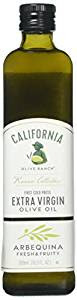
I gave a slightly more expensive California Ranch variety a try, the Arbequina, which was stronger, but slightly too sharp for me. I did eventually get my hands on a bottle of Olio Santo, and it's also stronger, but more mellow, so I prefer it. Now, I use the California Ranch for everyday cooking, and the Olio Santo for times when the flavor of the oil is front and center, such as in dressings.

California Olive Ranch Arbequina Extra Virgin Olive Oil

I've discovered that the best price for California Ranch Extra Virgin Olive Oil is at Target, especially when there's a sale or Cartwheel offer. If you're an Ina fan, and/or you want to try the Olio Santo, Amazon now offers a two-pack for $39, which is slightly cheaper per bottle than the $20 single bottle I've bought previously.

Do you have a favorite olive oil?

This post contains affiliate links that help support this site at no additional cost to you. Thank you for using them! You can read CFO's full disclosure here.

Sep 12, 2019

The Difference Between Living Within Your Means and Below Your Means Is Wealth

The concept of living within your means is a pretty straightforward one, and one that most people I know seem to generally subscribe to. In a nutshell, the idea is that you don't spend more money than you have. If you make $3,000 per month, you spend $3,000 or less each month.

This concept is certainly one that my parents taught me as I grew up. I remember my dad talking to me about credit cards, and not carrying a balance. I understood the concept of a budget, even though I never actually created one until after I was married.

In fact, it wasn't until after I graduated from law school, had a full-time income, and had to pay back student loans that I really started learning about personal finance.

It was around this time that I read The Millionaire Next Door, and it had a huge impact on me. For the first time, I understood what it means to live not just within one's means, but below one's means.

And I learned that the difference between the two practices is what leads to wealth.

The Difference Between Living Within Your Means and Below Your Means is Wealth

Take my previous example of an income of $3,000 per month. If you spend $2,900 per month, you're living within your means. But if you spend only $2,500 per month, you're able to save $500 - and if you build an emergency fund and then invest your monthly savings, you're on the way to building wealth. Reduce your spending to $2,000 per month and you're building wealth twice as fast.

I've been thinking about this concept a lot lately. It's been nearly ten years since I stopped working full-time as an attorney and became a part-time blogger/writer, mostly stay-at-home mom. When I was working, we lived well below our means. In fact, almost all of my income went into savings and toward paying off debt. Now, we still live below our means and continue to save, but not even close to what we used to put aside each month.

And yes, that means I've been thinking about going back to work outside the home, or finding a more lucrative work-at-home job. Because I would very much like us to live more below our means, so we are able to build more wealth (also known, at this point in our lives, as saving for college).

Even if you can't reduce your spending right now, this is a concept that's worth thinking about. When you get a promotion at work, or find a way to lower your expenses, instead of raising your standard of living, maintain expenses at the current level and tuck the increased income into savings. Then you'll be on your way to building wealth.

This post contains affiliate links that help support this site at no additional cost to you. Thank you for using them! You can read CFO's full disclosure here.

Sep 10, 2019

Savings.com: Get a New Phone at Verizon Wireless + Win VZW Gift Cards!

This post is sponsored by Savings.com and contains affiliate links that help support this site at no additional cost to you. Thank you for using them! All opinions are honest and my own. You can read CFO's full disclosure here.

My family has been a Verizon family for nearly 20 years, because the service is always reliable and the customer service is fantastic. Plus, even though we've gone from two to four users in the last three years, our bill has remained pretty reasonable - we pay $40 per month per line for unlimited data, talk and text (including a $5 discount per line for auto-debit). Considering how much data our family uses, it's a great deal.

Plus, Verizon has the best phones! Right now, you can get the Samsung Galaxy Note 10, featuring:
  • 30 minute wireless power-up 2.0 with long lasting battery life

  • 512GB internal storage and expandable to an extra 1TB with an external microSD card

  • Wireless PowerShare lets you pay it forward with no cables necessary

  • Stream, game or download at unbelievable speeds


And starting September 13, you can pre-order the all-new iPhone 11, which will be released on September 20. Specs on the 11 are being announced today, so I don't have details yet. But as soon as the 11 is available, you can see it on Verizon's Smartphones page.

We're an Apple family when it comes to phones, so of course, I'm most intrigued by the iPhone 11 - although I just got a new phone last year, so my husband will be upgrading before me. It'll be another iPhone, so he can keep all of the same apps, and we use iMessage constantly to communicate with each other as well as other family members. Plus the Live Photo option is fantastic, and you can take free classes at the Apple Store. (I happened to be there during a photo class and picked up some cool tips just by listening in.) Best of all, through September 30, Verizon has an upgrade offer of up to $200 off and 50% off Activation!
WIN IT!

It gets better, because you have multiple chances to win VZW gift cards!

First, head to Savings.com and enter for a chance to win one of FIVE $100 VZW gift cards!
Win a $100 Gift Card from Verizon Wireless


Then, RSVP for the #ChooseVZW Twitter Party, which will be on Friday, September 13th at 10AM PT/1PM ET. You could win one of (6) $25 Gift Cards, (2) $50 Gift Cards, (1) $100 Gift Card, or (1) $150 Gift Card!
#ChooseVZW Twitter Party


Good luck!

Sep 9, 2019

CFO Favorite: SodaStream Sparkling Water Maker

CFO Favorite: SodaStream Sparkling Water Maker

I've had a SodaStream for almost 10 years, since before the sparkling water craze hit grocery store shelves. I was lucky enough to win it from The Bragging Mommy, and it just might be the best prize I’ve ever won. It’s definitely the most used!


Ever since I received my SodaStream, I’ve been drinking unflavored sparkling water (the flavor mixes never did anything for me). And it’s so economical!

I drink at least 2 liters per day, which is equivalent to four 500 ml bottles. Each CO2 canister lasts me about a month, so it carbonates at least 60 1-liter bottles. The lowest price for an 8-pack of 500 ml bottles is $1.99. Sixty 1-liter bottles is equivalent to 120 500 ml bottles, or 15 8-packs. Fifteen 8-packs at $1.99 each comes out to $29.85, not including CRV (California Redemption Value) of 5 cents per bottle.

Each SodaStream CO2 canister refill is $14.99 at Bed Bath and Beyond, and they let you use coupons for them. A $5 off $15 purchase coupon (which they’ve always let me use for this purpose) brings the cost down to just $9.99. I don’t remember if they charge sales tax (I think they do), but even then I pay less than half the cost of buying individual bottles.

Plus, the SodaSteam has the added benefit of being much more environmentally friendly. Even though I do recycle, it’s best to use less plastic to begin with.

If you prefer flavored water, it's so easy to add slices of orange, lemon, lime, strawberries, and/or cucumber. You can also use an insulated tumbler to keep your sparkling water cold on the go. (All sparkling beverages - at least in my opinion - are much better cold!) There are also natural flavored syrups that you can get

There are a lot of different SodaStream options out there, and you might want to try the more expensive SodaStreams that come with flavor syrups if you're interested in them. (You could also try making your own flavored syrups.)

If you just want plain sparkling water, Amazon has a sparkling water maker for just $49.99. However, if you're just getting started, I recommend the water maker with one CO2 canister for $74.81 $63 (love a price drop!). A new CO2 canister is $29.99, so the combo is a better deal.

Sep 5, 2019

Traveling Abroad with Food Allergies

My family and I are planning our first trip abroad this winter, and it'll be the first time my son with food allergies will be out of the U.S. I've traveled all over, but I didn't fully appreciate the magnitude of this trip until I recently started researching tips for traveling abroad if you have life-threatening food allergies.

In a word: You need to plan ahead.

Of course, the scary thing is that even if you plan ahead, things might not go according to plan. I've read multiple stories about people who were unable to travel because the airline did an about-face and informed them at the time of their flight that it wasn't safe and accommodations would not be made.

Traveling Abroad with Food Allergies

Luckily for us (knock on wood), my son doesn't have any airborne food allergies, so the flights aren't my biggest concern. I'm more concerned with finding safe foods for him to eat at our destination, so I've started doing some research to prepare for our trip. If you're in the same boat, here are a few things I've learned (and if you have any tips to share, please let me know!):

Start at FARE, an organization whose "mission is to improve the quality of life and the health of individuals with food allergies, and to provide them hope through the promise of new treatments." They have an entire section dedicated to the topic of traveling with food allergies. I've already downloaded their Food Allergy Chef Cards, which you can print out in multiple languages and show at restaurants to explain your food allergy.

Then search for tips about traveling to your specific destination. Find out what the food labeling laws are, and how accommodating society as a whole is. You can also find tips on identifying safe places to eat, such as enlisting the assistance of the hotel concierge for possible locations nearby, or seeking out halal restaurants, because they usually know exactly what ingredients are in their food.

Of course, you should also carry epinephrine and any other medications at all times. In fact, I'll be ordering a refill so we can take extra epi-pens with us when we travel.

If you've traveled abroad with food allergies, how did you make sure the food was safe for you?

Sep 3, 2019

An Unexpected to Benefit To Not Deal Blogging (that can work for youtoo!)

I guess this makes sense, but I didn't predict it: not blogging about deals is saving me more money, not less.

It turns out - not surprisingly, when you think about it - that constantly finding hot deals makes them hard to pass up.

An Unexpected Benefit to Deal Blogging (that can work for you too!)

I was always pretty good about keeping my impulses under control, and not buying things we didn't need or wouldn't use. But sometimes I'd find a hot deal that I regretted - like the Fila sneakers I bought for the boys from Zulily one year that never actually got worn.

Fortunately, it got easier to restrain myself the longer I blogged. But still, a stock up deal is a stock up deal, and therefore, difficult to resist. In fact, I kept buying disinfecting wipes because Amazon kept having stock up prices on them, until I literally ran out of storage space in the cleaning supplies cabinet.

Not making a note of every awesome deal I come across has taken some getting used to. But because I can bypass the deals and not spend an extra second thinking about them, I'm a lot less tempted to spend money.

How does this apply to you? Well, it depends on how much temptation you find yourself facing. If you feel like you're frequently tempted by deals, then the best thing you can do is reduce your exposure to them. That might mean following fewer deal blogs or unsubscribing from emails from your favorite stores.

How do you know you're being too tempted? Well, like me, you might be out of storage space, or you might find yourself with items that seemed like a good buy but turned out to be a waste of money. (In my case, it wasn't just shoes and wipes, but also Shutterfly notepads, magazine subscriptions - though at least those were free, and more than I care to remember.)

I still keep an eye out for deals, of course, and have a running list of things I want to stock up on when the price is right. However, there are lot of deals I might have considered in the past that I don't even pause at, and my savings account is a lot happier for it.